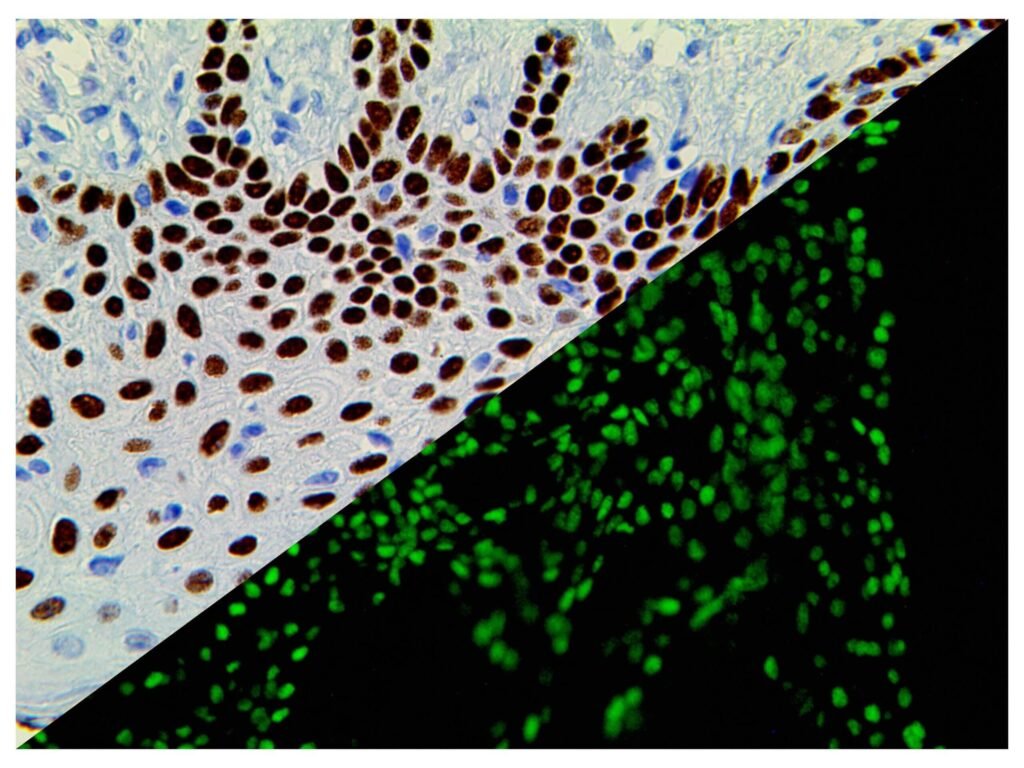
The P63 antibody (clone 4A4) is a highly reliable mouse monoclonal antibody widely recognized in diagnostic pathology and cancer research. P63 is a nuclear transcription factor from the p53 gene family that is strongly expressed in basal and myoepithelial cells of epithelial tissues. This makes it an essential marker for identifying squamous cell carcinoma, urothelial carcinoma, and breast lesions, while also serving as a key indicator of epithelial differentiation. In immunohistochemistry (IHC), clone 4A4 produces a robust nuclear staining pattern with high sensitivity and specificity, ensuring accurate and reproducible results. Clinically, P63 is especially valuable in differentiating between squamous cell carcinoma, basal cell carcinoma, and adenocarcinoma, while its strong expression in more than 90% of squamous cell carcinoma cases supports diagnostic confidence. In prostate pathology, the absence of P63 helps distinguish adenocarcinoma from benign prostatic glands, and in breast pathology, it aids in identifying myoepithelial cells, which is crucial when differentiating invasive carcinoma from in-situ carcinoma. This antibody is compatible with formalin-fixed paraffin-embedded (FFPE) tissues and works effectively with heat-induced epitope retrieval (HIER), making it suitable for both manual and automated IHC staining platforms. The P63 antibody clone 4A4 is available in concentrated and ready-to-use formats, with batch-to-batch quality control to guarantee consistent performance.
Mouse
Monoclonal
4A4
IgG2a
ICC/IF, IHC-P
Human, Mouse
Nucleus
Recombinant fragment corresponding to Human p63 aa 1-205.