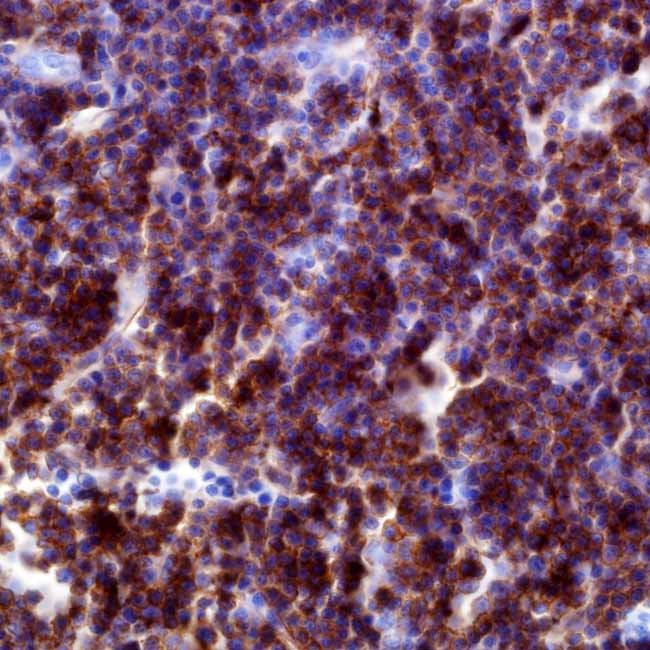
The CD23 antigen, a 45-60 kDa membrane glycoprotein, serves as a low-affinity receptor involved in IgE production and acts as a receptor for lymphocyte growth factor. CD23 is present in certain lymphomas affecting mature B-cells and within Reed-Sternberg cells observed in Hodgkin’s disease cases. 1 Within germinal centers, follicular dendritic cells and some activated B-cells exhibit CD23 at high levels, while B-cells in the mantle zone show weak staining. 2 Most chronic lymphocytic leukemias or small lymphocytic lymphomas test positive for CD23, in contrast to mantle cell lymphomas, which generally do not, making this marker valuable for distinguishing small cell lymphomas when combined with other markers. 2 Myeloid neoplasms, precursor B and T lymphomas, and mature T-cell lymphomas are CD23 negative, with occasional positivity noted in other small cell lymphomas. 3 CD23 also shows positivity on activated mature B-cells that express IgM or IgD, monocytes/macrophages, follicular dendritic cells, T-cell subsets, eosinophils, Langerhans cells, and small lymphocytic lymphoma or chronic lymphocytic leukemia (SLL/CLL).